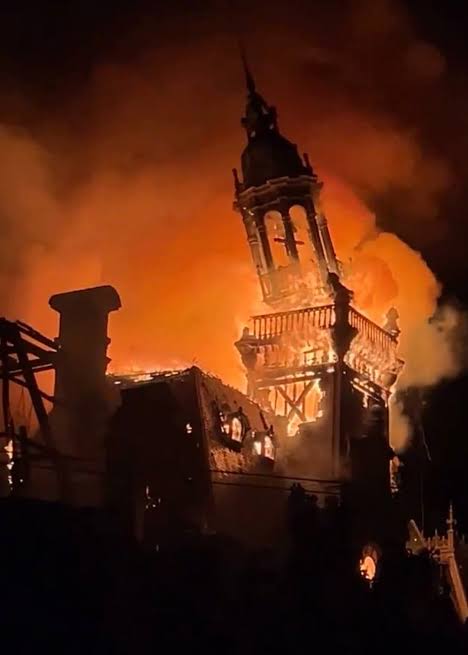
At first glance, the wave of protests that swept across France on 17 October 2026 appears to be the consequence of a deepening social and political crisis. Deteriorating conditions in education, rising living costs and dissatisfaction with public services brought hundreds of thousands of people onto the streets. Yet the demonstrations were accompanied by violence that went far beyond the bounds of conventional protest. Attacks on public buildings, arson, looting, road blockades and mounting pressure on law-enforcement resources characterised the events. The burning of Limoges’ historic city hall became a symbol of violence directed against French state institutions.
The genuine social grievances underlying the events in France cannot be disputed. Nevertheless, the structure and consequences of the crisis raise another possible interpretation: could the escalation of social discontent, economic damage, institutional destabilisation and international information influence be understood as elements of a coordinated, multi-domain grey-zone operation?
Michael J. Mazarr’s strategic approach provides a useful framework for understanding grey-zone conflict. Such operations are typically characterised by clear political objectives, the coordinated use of different-predominantly non-military-means, a deliberate effort to remain below the threshold of open armed conflict, and the gradual pursuit of strategic outcomes.
In Mazarr’s approach, the defining feature of a grey-zone operation is not any single instrument but the coordination of different instruments and the political effects they generate. Economic coercion, the exploitation of social conflicts, covert violence, political influence and information manipulation can combine to produce mutually reinforcing effects. Such a campaign can weaken a target state’s institutions without creating a clear basis for a conventional military response.
From this perspective, the events in France can be examined across five interconnected operational dimensions.
The first dimension is social mobilisation and the erosion of institutional trust. The discontent underpinning the French protests is genuine and affects several social groups. Students, trade unions, workers and networks associated with the Yellow Vest movement mobilised around different demands, but with partially shared political grievances. From a grey-zone perspective, precisely such pre-existing social fault lines constitute exploitable vulnerabilities. An external actor need not create or control protest movements. It may be enough to amplify particular disputes, demands or interpretations in ways that deepen political distrust and erode the social legitimacy of state institutions.
The second dimension is physical destabilisation and the diversion of law-enforcement resources. During the October events, apparently organised, fast-moving groups carried out attacks on police officers, shops and public institutions in several French cities. The burning of Limoges City Hall is particularly significant because municipal buildings are not merely administrative facilities: they also symbolise state authority and democratic institutions. Local authorities indicated that the attack appeared deliberate and premeditated, although the full organisational background of those responsible remains unclear. There is no evidence that the arson was directed by a foreign actor.
The strategic significance of physical violence, however, extends beyond the immediate damage. Such attacks tie up law-enforcement resources, compel governments to undertake crisis management and produce powerful visual material that can subsequently be used in information operations. Setting a building on fire can therefore cause physical damage, diminish institutional prestige and generate international political repercussions at the same time.
The third dimension is economic and infrastructure-related coercion. The protests in France involved road blockades, supply disruptions, looting and substantial damage to commercial property. Obstructions affecting the A480 and A71 motorways demonstrated how relatively small groups can disrupt everyday economic activity. Beyond the direct damage, uncertainty itself has a cost: businesses face greater operational risk, while the government must allocate additional resources to restoring public order and repairing the damage. Economic coercion can therefore indirectly constrain the state’s capacity to pursue other priorities, including defence and international commitments.
The fourth dimension is the intersection of cyber and information operations. Social media platforms played a significant role in preparing for and spreading the French protests. Accounts that emerged in September, some of them newly created, along with AI-generated protest material and extensive online reach, illustrated the potential of decentralised mobilisation. On 16 October, the website of the Les Républicains party was also hacked, and a message encouraging participation in the following day’s demonstration was posted. Digital activity does not, in itself, establish the existence of a foreign operation, but it shows how cyberspace can serve organisational, influence and destabilisation purposes during a social crisis.
The international framing of the events is even more revealing. Political and media circles close to the Kremlin, alongside some American and European sovereigntist figures, portrayed the unrest in France as evidence of failing European institutions, the consequences of immigration policy and the decline of Western societies. Kirill Dmitriev, a special envoy of the Russian president, explicitly linked the crisis to criticism of European energy policy and sanctions policy. The convergence of these narratives does not prove operational cooperation, but it illustrates how a domestic political conflict can be turned into an instrument of international strategic communication.
The fifth dimension is influence over political and geopolitical decision-making. With France’s 2027 presidential election approaching, the social crisis is also reshaping the political agenda. Figures on the left emphasise social grievances and government economic policy, while the radical right focuses on public security, immigration and institutional failures. These political actors need not knowingly cooperate with external sponsors for a foreign influence campaign to attempt to exploit their positions or their public support for its own objectives.
The potential geopolitical consequences are particularly important. France is one of Ukraine’s principal European supporters, actively participates in enforcing sanctions against Russia and has taken an increasingly firm stance against the so-called Russian shadow fleet. On 12 October, French naval forces intercepted the tanker DF Peak, while the European Union added a further 1,569 individuals and entities linked to Russia’s defence-industrial supply chain to its sanctions list on the same day. A prolonged domestic political crisis in France could therefore have consequences not only for domestic politics but also for European security policy.
The events in France must also be assessed against the wider evolution of hybrid threats in Europe. The invasion of Ukraine launched in 2022 failed to achieve its initial objectives of a swift military and political outcome. The protracted war, the sustained commitment of Russian military resources and continued Western support have created new incentives to employ indirect means of coercion. The risks of direct military confrontation with NATO are exceptionally high, whereas the political, economic and industrial systems of European countries supporting Ukraine may be targeted at a comparatively lower risk of escalation.
Against this backdrop, European security services have documented a growing number of acts of sabotage, arson attacks, attacks on infrastructure and operations conducted through intermediaries. According to CSIS figures cited by the Royal United Services Institute (RUSI), two serious incidents of sabotage or arson were identified in Europe in 2022, twelve in 2023 and thirty-four in 2024. Such operations frequently involve locally recruited operatives, sometimes with criminal backgrounds, making it harder to establish links to those who commissioned them.
One of the most significant examples of this shift is the arson attack against Estonia’s Milrem Robotics in August 2026. On 29 September, the Estonian Internal Security Service (KAPO) attributed the attack on the facility of the company, which develops autonomous ground systems, to sabotage commissioned by Russian intelligence services. The Estonian government explicitly linked the intensification of the European sabotage campaign to Moscow’s failure to achieve its strategic objectives in Ukraine, suggesting that Russia may seek results by intimidating and applying domestic pressure to countries supporting Kyiv.
The direct targeting of the defence industry is a particularly troubling development. The previously uncovered plot to assassinate Rheinmetall chief executive Armin Papperger, together with intelligence warnings in October 2026 about further threats to executives of European defence companies, suggests that some grey-zone operations are shifting beyond information and economic coercion towards direct physical damage, intimidation and violence against individuals. The potential targets now include not only military facilities but also civilian-run defence companies, suppliers and technology developers.
This evolution highlights a fundamental tension in Mazarr’s framework. Grey-zone strategies are designed to avoid high-intensity armed conflict, yet the means employed can become progressively more violent. Sabotage, arson or even a targeted assassination can form part of strategic coercion below the threshold of war, even where execution involves unmistakably kinetic violence. The more serious these acts become, however, the greater the risk of uncontrolled escalation.
Seen in this light, the parallel between the burning of Limoges City Hall and sabotage attacks against European defence companies does not imply a common perpetrator or shared operational command. Foreign involvement in the French arson attack has not been established. The parallel concerns the strategic effects of physical violence: both types of incident can generate intimidation, institutional uncertainty, significant material losses and political pressure. A deliberately constructed hybrid campaign could seek to exploit these consequences in pursuit of a common strategic objective.
The wave of protests in France cannot currently be characterised as a proven, coordinated grey-zone operation directed by a foreign power. Nevertheless, all five areas of effect that a multi-domain campaign could combine are present: social destabilisation, physical violence, economic coercion, cyber and information influence, and political-strategic consequences. Their simultaneous presence does not in itself demonstrate centralised control, but it does warrant an integrated assessment from a national security perspective.
For European defence planners, the central lesson is that the target of modern hybrid warfare is increasingly not simply military capability, but the functioning of the state as a whole. The defence industry, supply chains, public administration, transport infrastructure and social cohesion may become different elements of a single system of strategic vulnerabilities.
The next European security crisis may not begin with a military attack. It could begin with social discontent, continue through sabotage and violence against institutions, and culminate in political decisions that weaken a state’s ability-and that of its allies-to act.
The real danger of grey-zone warfare is that individual events may appear in isolation as domestic political crises, criminal offences or economic disruptions, while the strategic consequences of a possible coordinated campaign become apparent only later.
Europe’s response must therefore move beyond treating individual incidents in isolation. Defence-industrial security, critical infrastructure protection, intelligence sharing, societal resilience and continuity of political decision-making can no longer be managed as separate tasks. They are interconnected conditions for Europe’s strategic freedom of action.