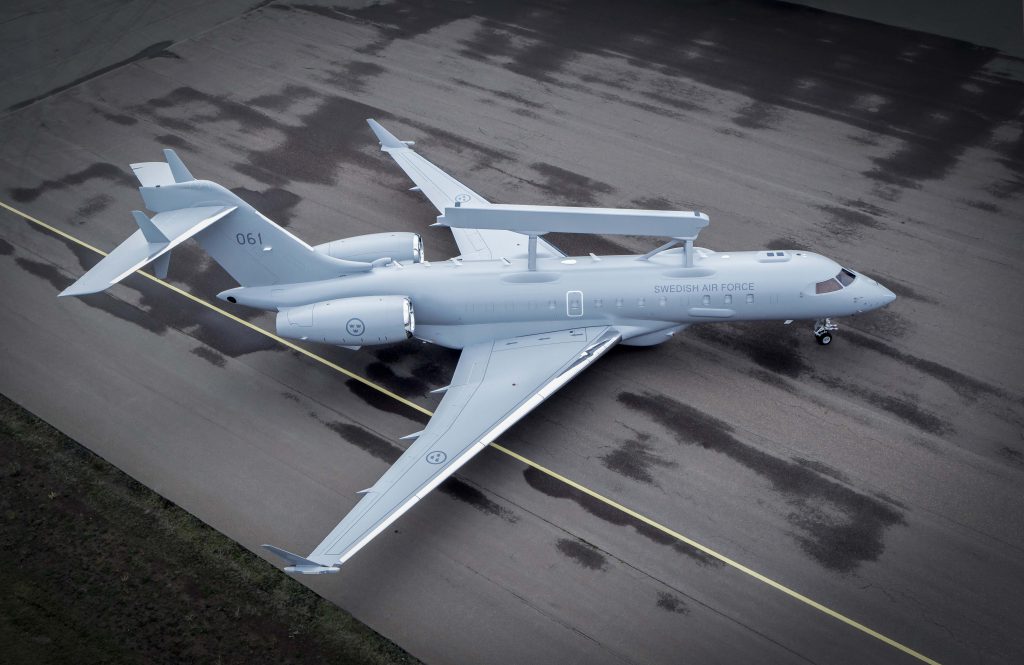
Europe’s defence ambitions face a delivery test: adopted law and allocated finance must become contracted, tested and accepted capability.
Key Judgements
- Five designated common-interest projects establish a framework, not five delivered capabilities.
- Omnibus V may reduce approval delays, but applicability and transposition require checking.
- Ukraine’s EDF association changes eligibility, not individual grant or security approvals.
- EDF application volume demonstrates competition rather than funded project outcomes.
- Shared testing infrastructure may be as important as new manufacturing investment.
- AIRSENSE’s over-land result does not prove robustness over feature-poor water.
- Industrial capacity must be measured in qualified, customer-accepted output.
Numbers that matter
- 102 working days – adopted permitting ceiling, subject to commencement and legal exceptions.
- 5 projects / €325m – initial common-interest designations and their EDIP allocation, not delivered capability.
- 612 / €1.006bn – EDF 2026 proposals and call budget; evaluation and awards remain pending.
- €115m – AGILE programme budget; future calls and practical conditions are not yet established.
- 400+ – EDA-linked test and evaluation facilities/capabilities; usable access remains decisive.
Next decision gates
- 10 Nov 2026 | UK Tactical Power Challenge first-stage deadline. Tests deployable-power innovation; watch funded procurement progression.
- 10–12 Nov 2026 – Bure | EU OPEX Switzerland. Watch trial results, military feedback and qualification follow-through.
- 17–18 Nov 2026 – Dublin | EDA sustainable-energy plenary. Watch specific energy-resilience decisions, not conference attendance.
- Early 2027 | Expected AGILE opening. Verify published rules before treating calls as open.
From announcement to execution
Defence Omnibus V
Next proof: Check applicability and national procedures | Why it matters: Applied rules determine actual permitting relief.
Five EDPCIs
Next proof: Requirements owners, contracts and acceptance plans | Why it matters: Designation is not fielded capability
Ukraine – EDF access
Next proof: Consortium security terms and signed grants | Why it matters: Access does not imply funded cooperation.
Editor’s Brief
November’s decisive shift is from measuring commitment to verifying military output. Five European Defence Projects of Common Interest have been designated, but none should yet be treated as fielded capability. Defence Omnibus V promises less procedural friction, subject to publication, commencement and national implementation. Ukraine’s new association with European defence instruments creates eligibility for collaborative projects, not automatic grants or contracts. Meanwhile, European Defence Agency experimentation and the AIRSENSE navigation trials show that technical progress must be assessed alongside limitations and user acceptance. Governments need clearer requirements and accountable programme owners; prime contractors need stable integration and testing arrangements; smaller suppliers need predictable demand and accessible qualification pathways. The issue follows these interdependent steps rather than treating legislation, factory announcements or innovation demonstrations as interchangeable evidence of readiness.
EDM ASSESSMENT
Europe’s immediate execution risk lies between promising programmes and accepted equipment. Faster permitting and wider eligibility can expand the project pipeline, but without funded procurement routes, qualified throughput, interoperable testing and named military acceptance authorities, they cannot guarantee operational readiness. The next 90 days should be judged by documented transitions between these stages, not by additional announcements.
Thematic Analysis
European policy is becoming more operationally demanding. Defence Omnibus V was adopted on 9 October with changes to permitting, intra-EU transfers and procurement; however, publication, commencement, and necessary national transposition remain separate legal tests. Similarly, the five designated European projects span drones, seabed protection, space, integrated air defence and eastern-flank surveillance, but designation leaves requirements, interfaces, responsibilities and contracting to be resolved. For governments and investors, the relevant comparison is no longer how many initiatives have been authorised. It is whether they acquire the accountable financing, qualified industrial capacity, and acceptance schedules needed to change the military balance in practice.
The innovation-to-acquisition gap is equally visible. Ukraine’s association with the European Defence Fund and industrial financing instruments opens new collaborative routes, while raising concrete questions about security, intellectual property and production governance. The AIRSENSE trials demonstrated navigation over land without dependable satellite positioning, yet exposed poorer performance over water; an operationally qualified system has not been established. The EDA’s testing network and field experimentation therefore matter as potential pathways to repeatable evidence, not automatic procurement. The full issue compares these technical and commercial thresholds with EDF competition, national contracts and SME entry routes, identifying where a promising development still lacks a military buyer.
What this means for
- Procurement authorities – Specify acceptance owners and test criteria before programmes move into contracted production.
- Prime contractors – Align cross-border interfaces, component qualification and sustainment before promising delivery rates.
- Armed forces – Convert field-trial feedback into measurable mission requirements and explicit go/no-go gates.
- SMEs / investors – Match a military sponsor to security-clearance, testing and payment arrangements before scaling.
Infographic preview
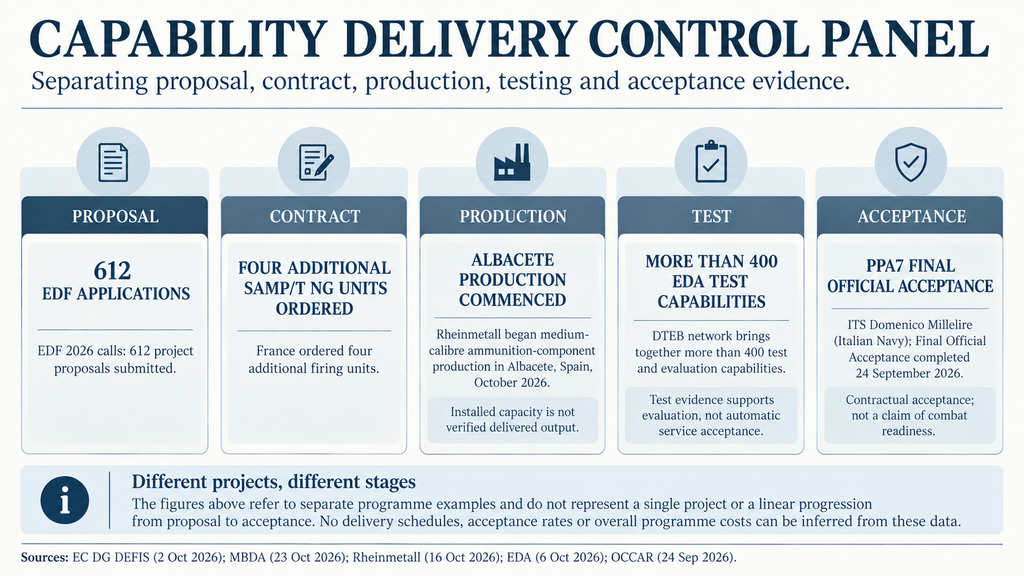
EDM Signal
- Demand signal – Strong: record EDF proposal participation.
- Procurement visibility – Mixed: signed orders coexist with early-stage joint projects.
- Industrial capacity – Constrained: qualification and test access require planning.
- Supplier access – Improving in law; practical contracting remains conditional.
- Execution direction – Pending: assess accepted output, not declared capacity.
What you unlock in the full issue
Inside the full issue: force architecture • space resilience • country execution • SME adoption • ownership and next-quarter gates
- Eight-stage delivery test – Trace proposed, authorised, funded, contracted, produced, tested, accepted and operationally deployed stages to identify responsibility gaps and programme dependencies across five European projects.
- Omnibus V legal implementation – Separate adoption from applicable procurement, permitting and transfer provisions before revising cross-border contracting strategies.
- Ukraine’s new industrial position – Examine EDF eligibility alongside intellectual-property control, protected technical data and credible production work packages.
- AIRSENSE under electronic attack – Assess terrain-dependent failure modes, validation evidence and qualification requirements before valuing GNSS-denied navigation claims.
- Funding, suppliers and national orders – Compare EDF/AGILE opportunities and procurement developments across France, Sweden, the UK, Spain, Romania, Poland and Germany.
Access the full October Issue
Access the full November issue for the evidence behind Europe’s capability-delivery test: legal implementation, industrial execution, testing constraints and supplier implications. European Defense Monthly provides a continuing monthly assessment of which defence announcements progress towards contracted, qualified and usable military capability – supporting more informed policy, procurement and market-entry decisions.