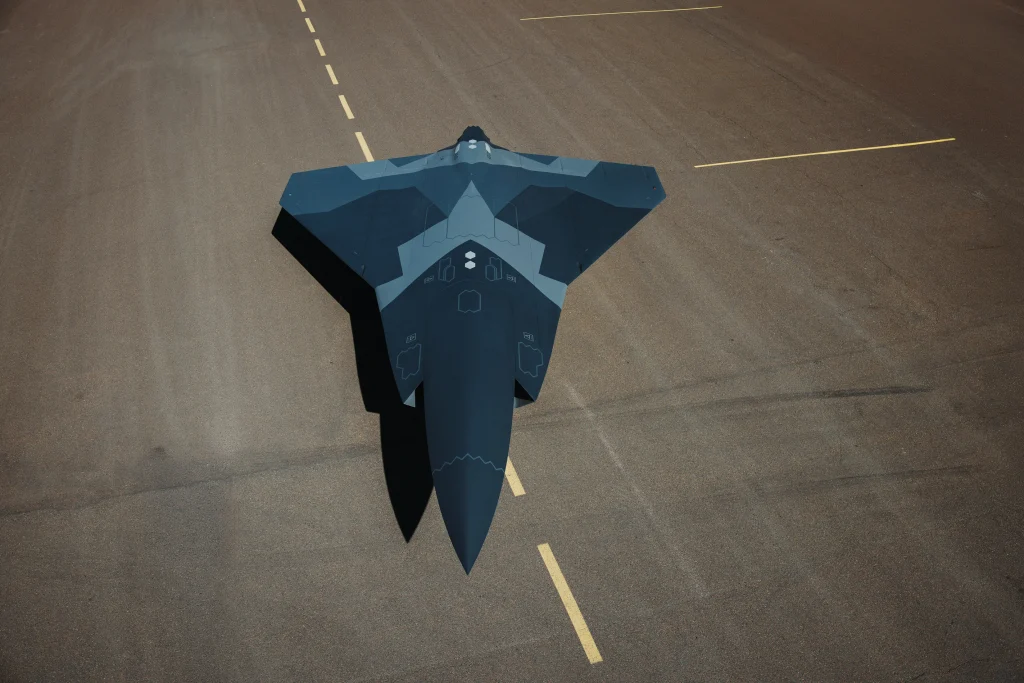
How space, autonomy, maritime power and arsenal depth are reshaping Europe’s force structure
Key Judgements
- Interfaces, integration and sustainment increasingly determine the operational value of nationally procured platforms.
- Sweden’s fighter work and A3-001 make crewed-uncrewed teaming an architecture problem, not a stand-alone drone category.
- IRIS2 and CASSIOPEE move sovereign space toward an explicit layer of European force design.
- Arsenal depth depends on production and replenishment as much as weapon performance.
- Autonomy at scale depends on orchestration, common interfaces and reduced operator burden.
- Strategic industrial value is likely to concentrate around mission software, secure connectivity and lifecycle control.
Numbers that matter
- € EUR3.7bn – Italy’s DDX programme, including the second-ship option.
- SEK2.9bn – Swedish 2026-2028 future-fighter concept order.
- EUR2.4bn / 264 – Aerospacelab’s IRIS2 contract and LEO platform count; 330 payloads are described by Thales Alenia Space.
- >5,000 – Strike-drone systems entering serial production in Germany.
- ~1.5m – Rheinmetall’s stated annual 155 mm shell-output target by 2030.
Next decision gates
- 21-23 October, Prague – Future Forces Forum – watch for common requirements, test criteria or procurement pathways.
- 3-6 November, France – EuroNaval – watch DDX follow-on work and open mission architectures linking high-end and autonomous systems.
- Q4 2026 – IRIS2 execution – watch platform, payload and ground-segment workshare for serial-production bottlenecks.
- By end-2026 – Rafale F5 launch – watch how AI, sensors, weapons and uncrewed teammates are assigned interface responsibilities.
- 3-4 December, Wiesbaden – LANDEURO – watch convergence between land-force requirements, deployable mass, sustainment and digital command.
From announcement to execution
EU OPEX 2026 | Experimentation
Next proof: Evidence recognised beyond the event | Why it matters: Reusable acquisition evidence.
Rafale F5 | Preparatory contracts
Next proof: Launch by end-2026 | Why it matters: Sets collaborative-combat interface authority.
IRIS2 | Industrial execution
Next proof: Q4 supplier bottlenecks | Why it matters: Tests repeatable sovereign space production.
Editor’s Brief
October shifts the centre of gravity from industrial allocation to force composition. Europe is simultaneously building sovereign space infrastructure, software-enabled combat-air architectures, renewed high-end maritime capacity and larger volumes of autonomous and lower-cost systems. These investments create combat power only when mission software, secure communications, interfaces, test evidence, production engineering and replenishment connect them into one force package. For governments and armed forces, this raises questions of integration authority, operator burden and regeneration. For primes, SMEs and investors, value is moving toward the layers that make systems interoperable, supportable and repeatable at scale – not only toward the platforms themselves.
EDM ASSESSMENT
Europe is no longer only deciding what to buy; it is deciding the operating architecture that determines whether scarce high-end platforms, autonomous mass, sovereign space and replenishable weapons function together under pressure. The decisive metric is the balance between nodes, mass and the connective industrial architecture behind them.
Thematic Analysis
Europe’s emerging force is a layered portfolio rather than a uniform expansion of legacy inventories. Scarce destroyers, combat aircraft and sovereign space systems provide sensing, command and survivable high-end effects; autonomous and lower-cost systems extend coverage, absorb risk and add magazine depth. What changed in October is that these strands are now visible as one force-design problem across Europe. The full issue develops how interface ownership, secure data exchange and lifecycle control determine whether national programmes combine into operational capability rather than remain separate acquisitions.
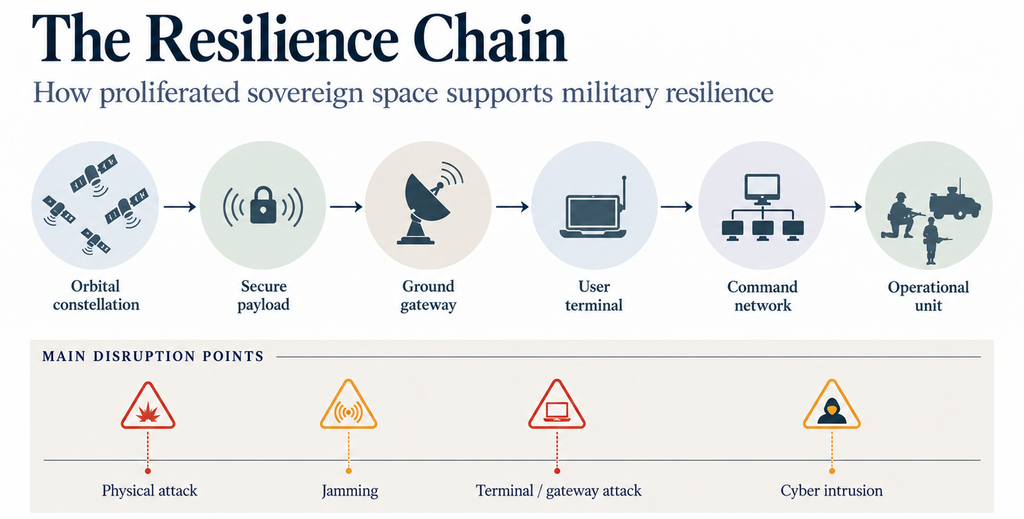
The second theme is regeneration. Ammunition output, serial drone production, distributed satellite architectures and operational experimentation all point to the same constraint: a force must be able to replace losses, update software, qualify new configurations and sustain tempo under pressure. REPMUS and EU OPEX shift autonomy from vehicle performance toward command architecture and test evidence, while Warfare Transformed shows that orbital distribution still depends on resilient terminals, gateways and ground networks. The full issue follows these dependencies into industrial bottlenecks, supplier access and procurement gates.
What this means for
- Governments / procurement authorities – secure interface access, configuration control and surge options so acquisitions remain integrable and replenishable.
- Primes / integrators – advantage increasingly sits in mission software, secure communications, payload integration and upgrade authority.
- Armed forces – test mixed force packages for operator burden, data flow, logistics and recovery, not only platform performance.
- SMEs / investors – tie funding and test access to qualification, manufacturability, customer pull and the next procurement gate.
Infographic preview
EDM Signal
- Demand signal – Strong: capital is reaching high-end nodes and affordable mass.
- Procurement visibility – Improving: DDX is contracted; Swedish concept work and German drone production are moving.
- Industrial capacity – Mixed: scale-up is visible, but bottlenecks and prospective conversion remain.
- Integration / orchestration – Strategic: software, secure communications and test evidence increasingly determine capability.
- Execution risk – Concentrated at interfaces, qualification pathways, critical suppliers and replenishment speed.
What you unlock in the full issue
Inside the full issue: force architecture • space resilience • country execution • SME adoption • ownership and next-quarter gates
- Force-design architecture – Monthly Focus plus both Priority Themes compare high-end nodes, distributed mass, replenishment and orchestration to clarify procurement trade-offs.
- Fighting Through the Constellation – Warfare Transformed follows IRIS2 from spacecraft to terminals, gateways, software and regeneration capacity, testing resilience beyond orbit.
- Seven-country procurement view – Italy, Sweden, the UK, France, Poland, Germany and Greece are compared through maturity, industrial participation, lifecycle support and production status.
- Funding-to-adoption routes – EDF 2026, BraveTech/EU OPEX, growth capital and the Osnabrück and INLEAP cases distinguish finance/test access from qualified capacity.
- Execution and ownership map – M&A and the outlook connect capability ownership and supplier strategy to Future Forces Forum, EuroNaval, Rafale F5, IRIS2 and LANDEURO.
Access the full October Issue
Access the full October issue to follow how Europe’s new spending translates into force architecture, industrial workshare and execution risk across named programmes, countries and supplier routes. European Defense Monthly provides a recurring monthly view of what has moved, what remains unproven and where the next decision gate sits.