Key Judgements
- Industrial location and lifecycle rights increasingly shape market access alongside platform performance.
- SAFE implementation is becoming an industrial-selection mechanism as payments move national plans towards contracts and qualified supplier workshare.
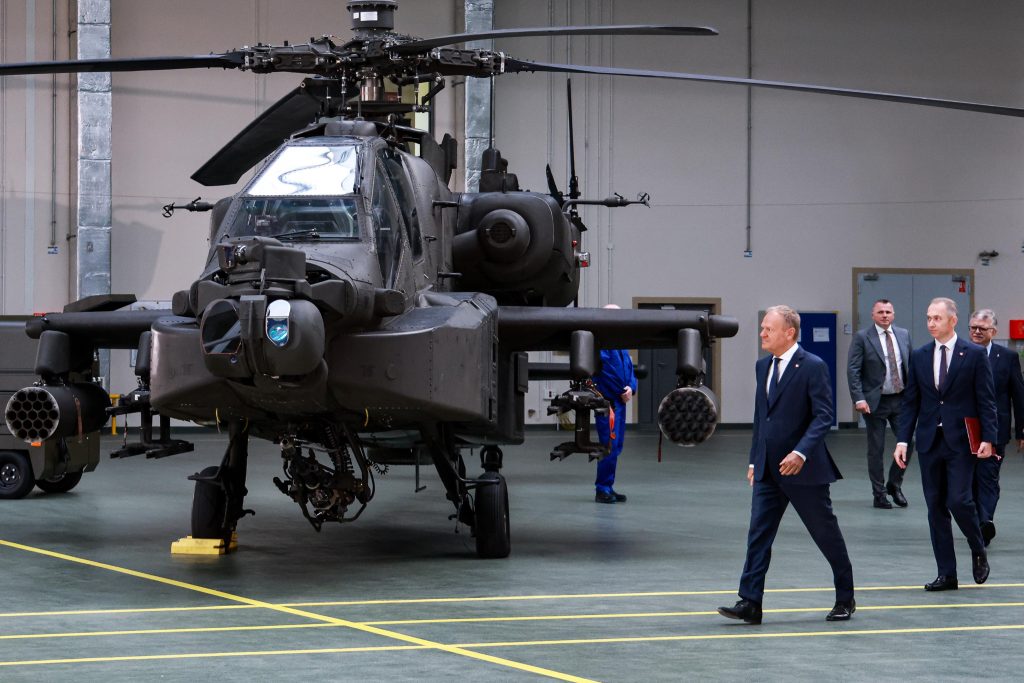
- Poland’s Apache service-centre agreements move localisation beyond assembly towards authorised lifecycle support.
- Romania links SAFE-backed procurement across several capability classes with domestic production-capacity development.
- European burden-sharing should be stress-tested through enabling-capability availability rather than assumptions of a binary US withdrawal.
- Counter-UAS adoption increasingly depends on layered interoperability and integration inside operational command chains.
- The defence-innovation bottleneck is shifting from grant access towards qualification, test evidence and adoption.
- Uncoordinated localisation could expand capacity while preserving fragmented architectures, sustainment systems and qualification regimes.
Numbers that matter
- €2.5bn – Romania’s first SAFE payment.
- €351.6m – Estonia’s first SAFE payment.
- €118.2m – Greece’s first SAFE payment.
- 96 – minimum Apache support capacity in Poland.
- >€500m – German mobile rescue-station order.
- SEK 1.2bn – Finland’s initial RBS 70 NG order.
- £135m – UK torpedo-support contract.
- €1.8m – Sentinel Strike prize pool.
Watchlist
- 8 Sep – FREMM arrangement, Rome → watch support, upgrades, technical data and industrial participation.
- 29 Sep – EDF 2026 deadline → workshare, IP and test roles harden → watch procurement links.
- 29 Sep-1 Oct – EDA Test & Evaluation Community Days, Kiel → watch reusable evidence and common testing.
- 21-23 Oct – Future Forces Forum, Prague → watch counter-UAS, resilience and digital requirements becoming supplier work.
- By 6 Nov – US posture options → watch affected missions and European enabling-capability requirements.
Editor’s Brief
Europe’s defence expansion is shifting from aggregate spending towards industrial allocation: who gains production lines, authorised sustainment, technical authority, qualified workshare and recurring revenues. SAFE is moving approved national plans into implementation, while Poland’s Apache support arrangements and Romania’s first payment show how procurement can create durable lifecycle and production positions. The US force-posture review adds a parallel test of European burden-sharing, centred on surveillance, air defence, fires, logistics, command-and-control and sustainment rather than headline troop numbers. For governments, armed forces, primes, SMEs, investors and market entrants, the decisive question is whether contracts create capacity Europe can control, replenish, upgrade and sustain under pressure.
Thematic Analysis
Industrial reallocation is the month’s central market story. SAFE payments to Romania, Estonia and Greece show financing moving from approved plans towards implementation, while Poland’s Apache service-centre agreements demonstrate how lifecycle rights can create a durable European industrial node around a non-European platform. Germany’s deployable medical infrastructure and Finland’s RBS 70 NG structure broaden the point: industrial value sits not only in final equipment but in repair authority, trained labour, spares, training, logistics and recurring support. For ministries and primes, localisation is therefore becoming part of system architecture and lifecycle planning rather than a late offset negotiation. For SMEs, the threshold rises from participation to qualification, production repeatability and long-term supplier relevance. Over the next 30-90 days, the decisive evidence will be whether SAFE allocations and major procurements convert into signed workshare, identified facilities, domestic production, MRO, technical-data access and support rights that remain valuable after initial delivery.
The transatlantic question is becoming an enabling-capability question. The confirmed US force-posture review does not establish a major withdrawal, but it gives European planners a concrete reason to test where NATO operations would face constraints if US availability were rebalanced. The issue highlights airborne surveillance, integrated air and missile defence, long-range fires, logistics, C2, intelligence, mobility, medical support and sustainment. Baltic Trust 26 shows the same logic tactically: resilience depends on integrated sensors, communications, effectors and command systems rather than one product. This matters commercially because suppliers of enabling systems, maintenance, secure networks, test support and ammunition can become strategically important without being headline-platform primes. Over the next quarter, the key signal is which missions and enablers any posture adjustment affects, and whether European responses preserve NATO interoperability through deeper sustainment, co-production, software access, second-source qualification and investment in long-lead support capacity. Innovation policy is moving closer to the adoption problem. EDF 2026 offers SME and disruptive-technology routes alongside specified work in AI, seabed protection and CBRN, but the issue consistently separates funded R&D from qualification and procurement. Sentinel Strike illustrates the gap: common field testing can create comparable evidence, yet it does not guarantee an order. Smaller firms still need configuration control, safety and security evidence, manufacturing repeatability, export compliance, integration capability, working capital and a credible customer pathway. The same logic shapes procurement and investment: recurring support and certified capacity carry growing value, while trusted capital can influence market access. Over the next 30-90 days, the 29 September EDF deadline and European test-and-evaluation activity should be watched for consortium workshare, background-IP protection, evidence portability, test capacity and clear responsibility for transition from successful demonstration into deployable, supportable and eventually procurable capability.
What the full issue adds
- The Monthly Focus applies four allocation tests – production, lifecycle, supplier depth and capital/dependency – to current procurement signals, separating visible localisation from controllable industrial position.
- The SAFE analysis maps supplier positioning from national requirements through prime selection and financing eligibility, then follows conversion from allocation to recurring workshare.
- R&D and SME coverage follows FaRADAI, Sentinel Strike, TF RAID and EDF routes through testing, qualification, assurance, working capital and adoption.
- Country coverage compares Germany, Poland, Romania, the United Kingdom, Finland, France and Greece, showing where MRO, spares, infrastructure and technical authority create durable value.
- The Future Outlook links FREMM, EDF, European test infrastructure and the US posture review to near-term decision gates for procurement and market-entry planning.